
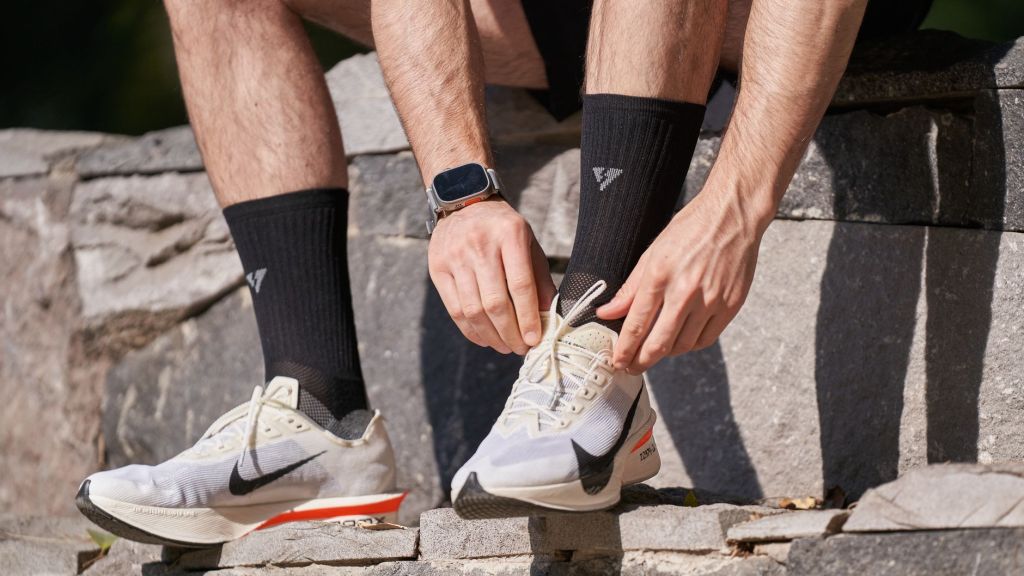
If you’ve ever been told to replace your running shoes every 300–500 miles, you’ve probably wondered where that number comes from.
Is it based on research, or is it simply a rule runners have followed for years?
The research suggests that running shoes gradually lose some of their cushioning and mechanical properties with use. However, there’s no exact mileage when every shoe needs to be replaced.
Where Does the 300–500 Mile Rule Come From?
One of the early studies examining running shoe durability was published by Cook and colleagues in 1985. Researchers tested running shoes to determine how much shock absorption they retained after repeated use.
They found that shoes gradually lost their ability to absorb impact, with some showing substantial reductions in cushioning between 250 and 500 miles.
Interestingly, neither price nor brand reliably predicted how well a shoe held up. Some shoes that initially offered more cushioning also lost it faster.
This research helped establish the mileage guidelines that runners still hear today.
What Happens to Running Shoes Over Time?
Most running shoes rely on foam midsoles to provide cushioning and absorb some of the forces associated with running.
With repeated loading, these materials change.
Research examining EVA foam, commonly used in running shoes, has demonstrated structural changes and increased pressure under the foot as the material ages.
Other studies have found that different midsole materials respond differently to repeated loading. Some become stiffer and lose their ability to absorb energy.
The important point is that a shoe can look relatively good on the outside while its midsole has already experienced significant wear.
Do Newer Running Shoes Last Longer?
Modern running shoes have introduced new foam technologies and carbon-fiber plates designed to improve running performance.
However, improved performance doesn’t necessarily mean improved durability.
A 2024 study published in the Scandinavian Journal of Medicine and Science in Sports examined how running shoe performance changed after 450 kilometers of use.
Researchers found that shoes using PEBA foam lost their running economy advantage, while the EVA shoes showed no significant decline.
This is particularly interesting for runners who invest in expensive racing shoes. The performance benefits you initially experience may not last throughout the shoe’s entire lifespan.
Is Comfort a Better Indicator Than Mileage?
Mileage is useful, but it doesn’t tell the whole story.
A 2025 study published in the European Journal of Sport Science examined the relationship between perceived shoe cushioning and running injuries. Researchers found that runners who perceived greater cushioning had a lower risk of injury during follow-up.
This doesn’t establish a specific replacement mileage, but it suggests that how your shoes feel may be worth paying attention to.
If your shoes suddenly feel flat, hard, or less comfortable, don’t ignore it simply because you haven’t reached 300 miles.
When Should You Replace Your Running Shoes?
The 300–500 mile guideline is a reasonable starting point, but several factors influence how long a shoe lasts:
- Running volume: Higher mileage means more repeated loading of the midsole.
- Body weight: Greater loading may influence how quickly materials change.
- Running surface: Different surfaces create different demands on the shoe.
- Running mechanics: Individual loading patterns can contribute to uneven wear.
- Shoe construction: Different foam materials and designs have different durability characteristics.
Look for changes in cushioning, visible midsole compression, uneven outsole wear, or new discomfort that consistently occurs when running in a particular pair.
If you rotate multiple pairs of running shoes, keep track of the mileage on each pair rather than your total weekly mileage.
The Bottom Line
Running shoes don’t suddenly stop working at 300 or 500 miles. Their cushioning and mechanical properties gradually change with use, and different shoes wear out at different rates.
For most recreational runners, 300–500 miles is a reasonable replacement guideline. However, comfort, performance, and visible wear should also influence your decision.
Don’t replace shoes simply because you’ve reached an arbitrary number, but don’t ignore changes in how they feel either.
Your running shoes are an important part of your training. Pay attention to how they feel, track their mileage, and replace them when they’re no longer doing the job you need them to do.
Strength Beyond Service: Building strength, improving health, and creating a more resilient body.
Research
- Cook SD, Kester MA, Brunet ME. (1985). Shock absorption characteristics of running shoes. American Journal of Sports Medicine.
- Verdejo R, Mills NJ. (2004). Simulating the effects of long distance running on shoe midsole foam. Journal of Biomechanics.
- Wang L, et al. (2012). Research examining the mechanical properties of EVA and polyurethane running shoe midsoles. Journal of Sports Sciences.
- Chambon N, et al. (2014). Research examining the effects of mechanical aging on running shoe midsoles.
- Escamilla-Martínez E, et al. (2020). Research examining plantar pressure changes in recreational runners over a training season. International Journal of Environmental Research and Public Health.
- Rodrigo-Carranza V, et al. (2024). Research examining changes in running economy following shoe wear. Scandinavian Journal of Medicine and Science in Sports.
- Malisoux L, et al. (2025). Research examining perceived cushioning and running injury risk. European Journal of Sport Science.


Leave a Reply